


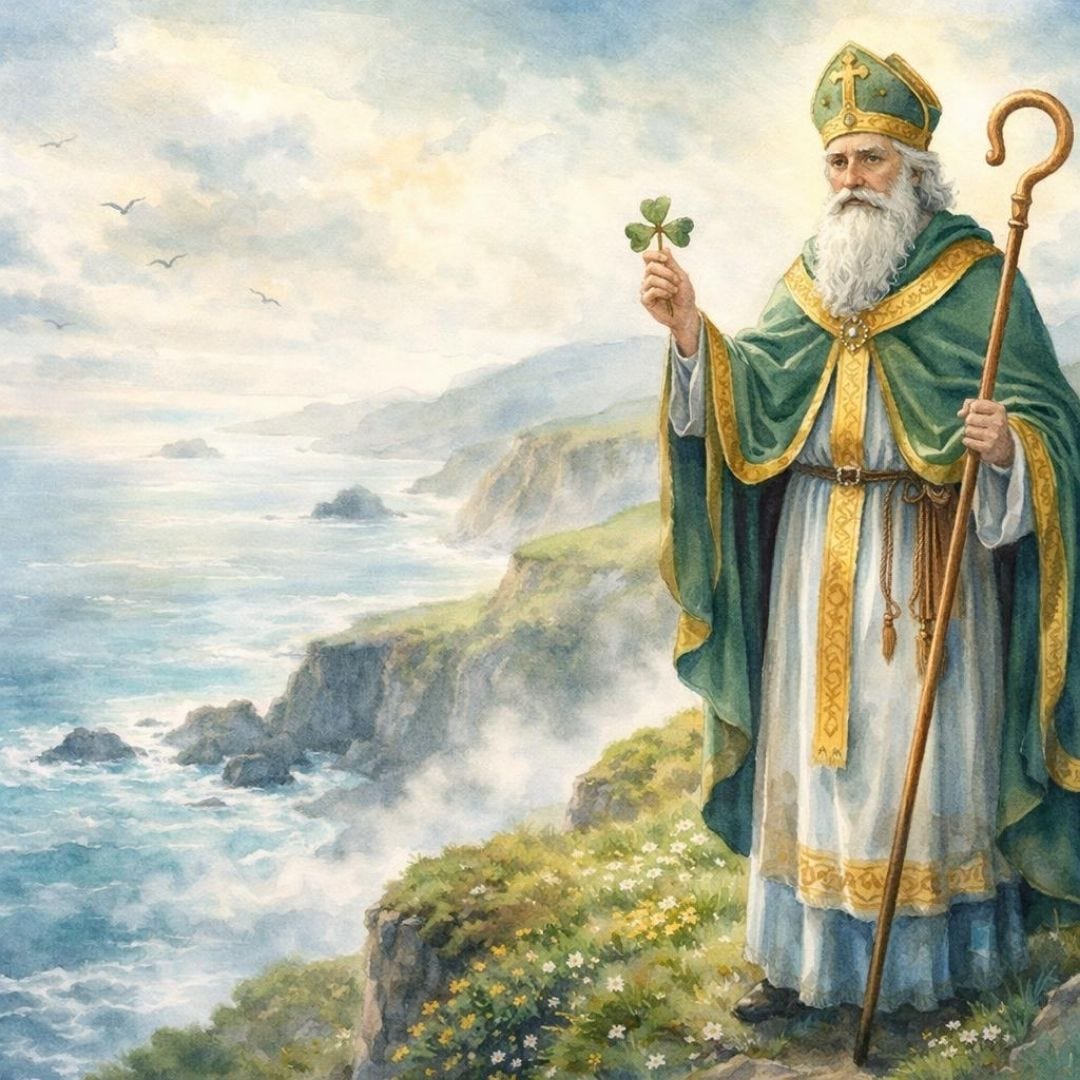
Get the coloring page at teapotfulloftales.com/037.
Watch the video on YouTube.
Got a story idea? Leave a message here.
Every March, the world is once again awash in shamrocks – three-leaf clovers. Shamrock cookies, shamrock necklaces, shamrock shirts, even shamrock sunglasses. Of course, all of this is for St. Patrick’s Day, which, at least in the United States, has largely become an occasion for green milk and frantic searches for your green sweater lest you face a flurry of pinches all day.
But St. Patrick is one of the great saints of the country of Ireland and of Irish people everywhere. How is it that this missionary who spread the Faith so remarkably has been reduced to leafy ground cover?
The story starts 1,600 years ago…
“Come along, Eithne!” Fidelma shouted over her shoulder. Her red hair streamed behind her like so many flames as she disappeared into the fog that hugged the banks of the stream.
Eithne continued her reverent walk. “‘Tis not a race, sister.”
Fidelma reappeared through the gloom, cheeks as ruddy as her hair. “I said not that it was a race. Is it not a beautiful day, though? Who knows what mystery will be around the next bend?”
Eithne shook her head at her sister’s youthful folly. “Still, we must conduct ourselves well. It does not do to approach Brigit’s sacred spring with such a disposition. You will surely anger the goddess of the waters.”
Fidelma nodded obediently and followed meekly in her sister’s wake. Before long, though, she was flitting off the path to gather some early primroses that were starting to poke up their heads. She caught a withering glance from her stoic sister. “What of it? I am merely preparing an offering for the water spirit.”
“Of course you are,” said Eithne. She knew her sister meant well, but she never stopped to look before she leapt. Then again, she thought, I can never bring myself to leap at all, so perhaps she has the better part after all.
The two of them came at last to the final hill before the sacred spring. The air hung thick with the weight of the mystical world just beyond the veil. Even Fidelma calmed herself in the presence of the sacred.
As the pool came into view, however, they were met with a most extraordinary sight. There seated on the grass were half a dozen men all dressed in simple robes. They were chanting their prayers in unison. Fidelma’s breath caught in her throat at the melody’s haunting beauty.
Eithne, on the other hand, was not so easily moved. Yet, she was loath to go nearer to these strange men. They seemed so gentle, but one can never be too careful.
When their prayers seemed to cease, she said, “Dear sirs, would you permit us to approach the sacred waters?” She swallowed hard, trying to keep her voice from faltering. “We wish to make our offerings to the goddess and bathe our hands in her blessing.”
One of the men looked up at her with smiling eyes. He seemed to be the leader, but when he spoke, he had an accent from afar – perhaps from across the sea. “Of course. We would not prevent you. We are merely praising our God, the one true God, on this fine morning.”
Eithne hesitated, glancing nervously at the spring. “Good sirs, you must be confused. This is the spring of Brigit, goddess of healing waters and sacred wells. How can you worship your own God here? Will she not be wrathful?”
The man looked at her kindly but with a disarming seriousness. “We worship the God who made the heavens and the earth. Every river, every spring, every drop of water was formed by Him alone. So, we worship Him anywhere and everywhere, for all the earth is His.”
Fidelma’s heartbeat quickened. Imagine it: knowing Him who made the whole world. What is a goddess of water to that? Before she could stop herself, she blurted, “What is the name of your God? I wish to know Him, too.” Immediately, her cheeks grew red, but she kept her eyes on the man nevertheless.
“We believe in God the Father Almighty, maker of heaven and earth; in Jesus Christ His only Son, our Lord, who died for our sins and rose again; and in the Holy Spirit, the Lord and giver of life.”
Eithne raised an eyebrow. “That is three gods by my reckoning. You said there was but one.”
The man nodded. “Indeed, we believe in but one God, yet our God is most wondrous, for He exists as three Persons sharing one divine nature. Three, yet not divided; one, yet not mixed.”
“What nonsense,” Eithne scoffed, though her voice wavered slightly. “Do you hear this madman, Fidelma? He thinks there can be three and one at the same time.”
But one look at Fidelma made Eithne’s heart drop: she was staring enraptured at the men, hungry to know more. “That is most odd,” Fidelma agreed, “but look at them, sister. There must be some reason here.”
Eithne did not want to believe what they were saying; that would mean abandoning the gods their family had worshiped for all time. Yet, the joy, the peace, the kindness radiated off these men like a restoring hearth on a bitter morning. The truth beckoned to her across the waters of doubt.
“Let me show you,” the man said. He reached into the grass and plucked out a common shamrock, like those that cover every hill and dale of the whole island. “Consider this three-leaf clover. It has but one stem, indeed there is but one shamrock. Yet, there are three leaves, each its own but still one plant.
“Of course, God is much more than this, His divine nature beyond our understanding, yet this has been given to aid our weak minds. He has given us much more besides. Think of the sun itself, the light it gives, the warmth it brings; again three ways of knowing but one thing.
“Or even this very spring: a source from the depths, a stream that flows, and pools of still water – once more three, yet one. The world is full of three in one.”
Eithne stared at the little leaf, hardly daring to believe that such a thing could be true. How could such a God exist? Yet, there was something about these men, this man that intrigued her. And Fidelma was clearly already enthralled.
Finally, Eithne bowed her head. “Sir, I too wish to know more about this God. Please, will you tell me who you are and how I can know your God better?”
“I am Bishop Patrick, come to bring the Good News to your people,” said the man. “And I would love to tell you more.”
Words trickled between them like the water of the spring blessed anew as the day wore on, words of Christ’s teachings and the new life promised for those who believed. As the sun sank into the west, the two young women knelt beside Brigit’s spring to bathe. But instead of asking for the blessing of the goddess, they were baptized in the name of the Father and of the Son and of the Holy Spirit, the one true God in three Persons.
In the years to come, both Eithne and Fidelma would themselves become saints, helping to spread the Gospel all over Ireland. Wherever they went, they remembered the spring morning when they encountered a living saint with a little shamrock that taught them the wondrous nature of God.
St. Patrick might never have used the shamrock to explain the Trinity; the story comes from a much later tradition. What we do know is that the people of Ireland have St. Patrick to thank for bringing the Faith to the island and teaching people, the great and small, about God. So, the next time that you see a shamrock hat this March, remember good St. Patrick and the one God in the three Persons whom he loved and served so faithfully.


